Business Location Germany
Germany’s “Growth Booster”
Germany is changing its tax regulations, including corporation tax rates and depreciation allowances, with the explicit goal of stimulating growth. For companies, the message is clear: The time to invest is now.
Jun 03, 2026
Amidst all the measures Germany has undertaken under the government led by Chancellor Friedrich Merz, the Wachstumsbooster, or growth booster, has flown somewhat under the radar.But it has the potential to be a boon for businesses, particularly those willing to put money into the future.
“We are stimulating the economy,” said German Finance Minister Lars Klingbeil at the announcement in late summer 2025. “We are giving businesses the planning certainty that they urgently need, and we are creating powerful investment incentives. We will make Germany more competitive internationally as a place to do business.”
The growth booster package brings in more generous depreciation allowances and a phased reduction in corporate tax rates. The immediate and eventual cuts are aimed at enhancing Germany’s competitiveness, innovation, and appeal to international companies. And they’re part of a wider effort to encourage German enterprise to increasingly spur growth in the country.
The larger “Made for Germany” initiative will see 105 companies have pledged to invest a total of EUR 735 billion in Germany by 2028. The list of investors reads like a “Who’s Who” of the global economy, including Airbus, Bain Capital, BlackRock, Blackstone, Coca-Cola Europacific Partners, Daiichi Sankyo, GlobalFoundries, O2 Telefónica, Microsoft, and NVIDIA, alongside German multinationals such as BMW, Boehringer Ingelheim, Bosch, Deutsche Bank, and Siemens.
"We are not just talking about ‘Made for Germany’ – we are delivering”, said Roland Busch, President and CEO of Siemens, at the time, underscoring his support for the government’s reform drive.
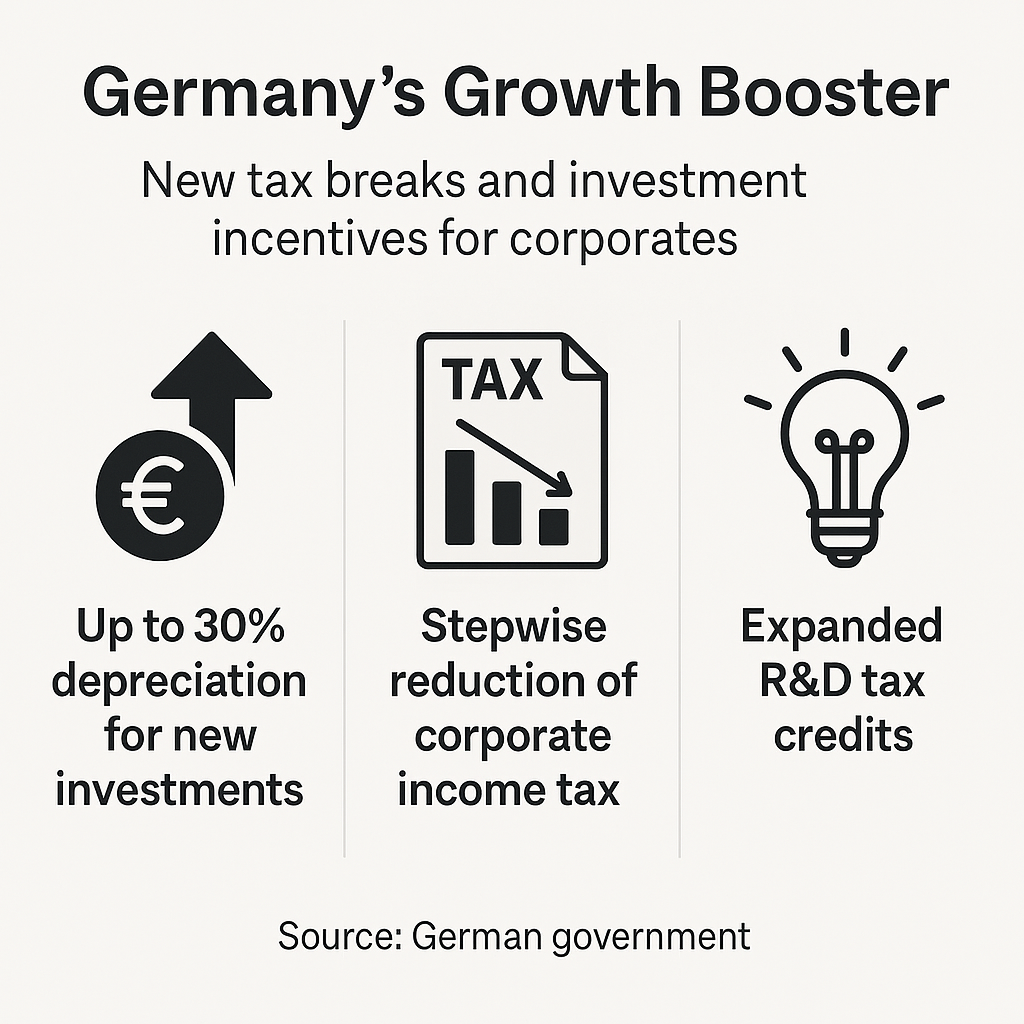
The tax reforms in the growth booster will reward businesses for their efforts. Here’s a breakdown of what’s new:
1. Accelerated depreciation – up to 30 percent
According to the ‘straight-line depreciation method’ companies can depreciate movable assets at a standard rate. That means investments in machinery and equipment take years to show up as tax savings, which drags on cashflow.
Germany is now introducing a declining balance depreciation for movable fixed assets as an investment booster. Companies can depreciate three times the amount that would be possible with straight-line depreciation, up to a maximum of 30 percent of the book value or residual value per year.
This will make it quicker for companies to refinance investments because they can write off a much larger portion of their investment in the first years, freeing up capital. In turn, that makes Germany more attractive to companies looking for fast returns. The new tax rules apply to investments made after 30 June 2025 and before 1 January 2028.
2. Gradual reduction of corporate tax burden
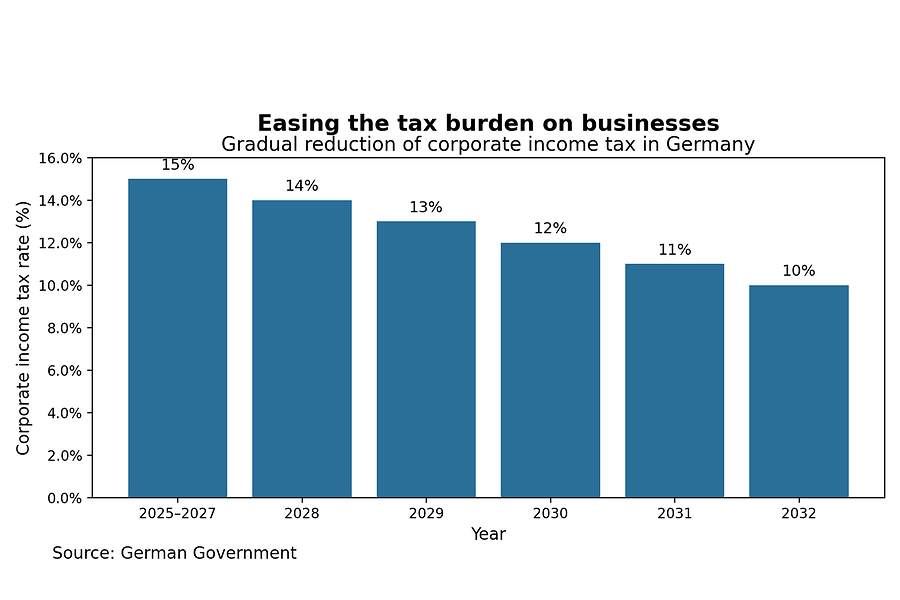
The growth booster reduces the overall tax burden for corporations, with rates set to fall incrementally over the next few years. From 2028 onwards, the corporate income tax rate will be reduced by one percentage point a year – from the current 15 percent to 10 percent. The German government expects the overall tax burden on companies to fall from around 30 percent at present to around 25 percent in 2032.
The cuts will make planning and investment easier, as Udo Sellhast, legal and tax expert at Germany Trade & Invest’s Investor Support Services team, explains: “These reforms will make Germany even more attractive as an investment location for international companies setting up subsidiaries or branches in Europe’s biggest market,” he says. “The accelerated depreciation offers short-term tax relief to corporations. The gradual reduction in corporate tax by five percentage points between 2028 and 2032 provides companies with long-term predictability in tax matters when considering investments in the coming years.”

3. Boosting R&D investment
Germany supports research and development (R&D) through a wide range of funding programs, many of which are focused on specific topics and offer preferential terms for small and medium-sized enterprises (SMEs). In 2020, the government introduced R&D tax credits to provide more flexible support for corporate research activities. So far, the incentive has proven to be effective.
The growth booster expands those R&D tax credits further. Companies of all sizes operating in Germany can now claim more generous deductions for research spending and tap into a transparent and well-funded innovation ecosystem. This includes raising the maximum assessment basis for the tax research allowance from EUR 10 million to EUR 12 million.
“The research allowance gives companies maximum flexibility in their R&D projects”, says GTAI business consultant Michael Schnabel. “It can be applied for at any time, is not subject to any thematic requirements and is open to companies of all sizes. The increased eligible costs and the possibility of a cash refund if no tax deduction is possible are particularly attractive. This makes the research allowance a flexible instrument for research and innovation in Germany.”
Outlook: A new investment landscape
Germany remains by far the largest economy in the European Union, with a GDP of over EUR 4.3 trillion and a central position in the single market. The growth booster is designed not just to stimulate domestic investment, but to attract global capital and talent.
The reform package offers improved returns, a more agile regulatory environment, and a renewed commitment to innovation. For global companies weighing up their next move, it is an invitation to participate in Europe’s most ambitious investment story.
- Business Location Germany
- Business Location Germany