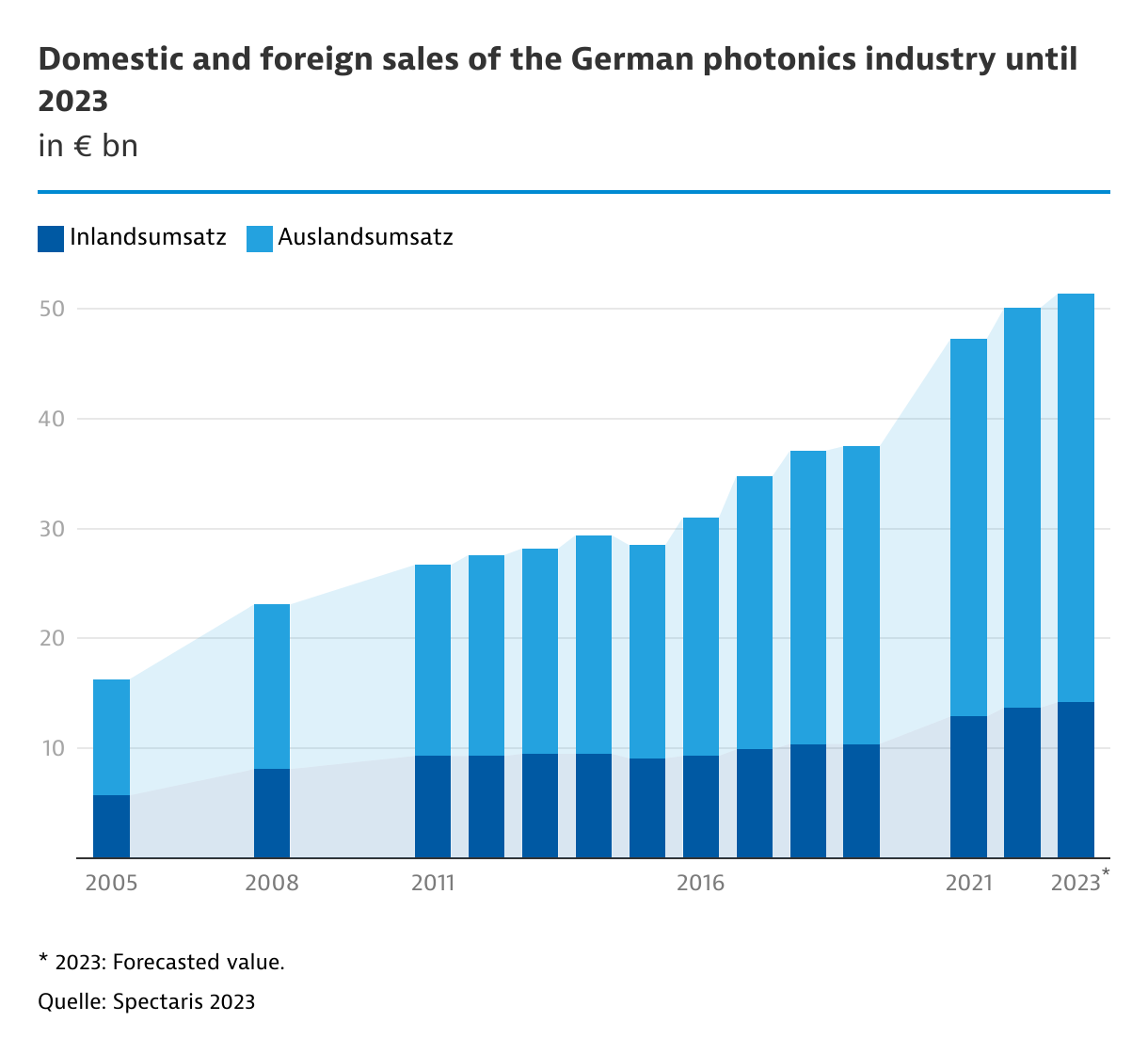
record turnover in 2024

Your company is already operating in Germany and you would now like to export worldwide?
Strong Revenue Base
Germany’s photonics industry generated EUR 50 billion in sales in 2024. The sector confirmed its position as one of the country’s most dynamic high-tech sectors – even in a subdued economic climate.
Large and Highly Skilled Industry Workforce
The German photonics ecosystem comprises around 1,000 manufacturers employing approximately 188,000 people. This ecosystem forms a robust industrial base that spans SMEs, hidden champions and global leaders.
Export-driven Competitiveness
With an export share of 76 percent, Germany’s photonics industry ranks among the most globally connected sectors. The EU accounts for 45 percent of all exports, followed by Asia (23 percent) and North America (14 percent respectively.
European Production Leader
Germany is Europe’s largest photonics producer, responsible for 39 percent of total European output. This is equivalent to around six percent of global photonics production.
Innovation at Scale
Photonics companies in Germany invest over 10 percent of their annual turnover in research and development. This underscores the industry’s above-average innovation capacity and its role in driving future technologies.
Emerging Technology Demand: Defense & Security Rise
Geopolitical developments are rapidly increasing demand for photonics solutions in defense and security, elevating this segment to one of the fastest-growing application fields within the German photonics industry.
Medical imaging, diagnostics and laser-based therapies are among the major application fields of the German photonics industry. Healthcare and wellness represent a significant share of domestic photonics production.
Production technology, Industrie 4.0, healthcare and optical components account for around 60 percent of Germany’s photonics production value. These sectors form the country’s most substantial and technologically advanced photonics segments.
The defense and security segment is gaining increasing importance in response to the global geopolitical situation. This includes growing demand for laser systems, advanced imaging and optical sensor technologies.
Components and materials account for 14 percent of global photonics market demand – representing one of the sector’s core segments. Germany maintains a strong position in precision optical components, coatings and specialty materials.
Environment, energy and lighting applications constitute 17 percent of global photonics demand. German companies are active across lighting, environmental sensing and sustainability-oriented photonic technologies.
The global quantum photonics market is projected to expand from approximately EUR 0.35 billion in 2023 to around EUR 2.9 billion by 2030 – equivalent to a compound annual growth rate of 32.2 percent. This development is consistent with Germany’s policy focus on quantum technologies including applications in computing, sensing and secure communication.
1. Government Support and Strategy
The German Federal Ministry of Education and Research (BMBF) continues to support photonics research as a strategic priority. The long-standing “Optical Technologies – Made in Germany” program illustrates the government’s continued commitment to strengthening Germany’s leading position in photonics. Today this support is embedded in broader national frameworks for digital and industrial key technologies. Through these initiatives, the government promotes innovation, advances research partnerships between industry and science, and works to secure a highly skilled workforce for the photonics sector.
2. Strong Government Commitment Through the High‑Tech Agenda Germany
Germany’s High‑Tech Agenda strengthens national competitiveness with major investments in AI, quantum technologies, microelectronics, biotechnology, and climate‑neutral energy and mobility— areas all highly relevant to photonics. The agenda accelerates the transition from research to industrial application and aims to secure technological sovereignty
3. Robust Industry Associations Strengthening the Photonics Ecosystem
Germany’s photonics landscape is supported by well-established industry organizations such as SPECTARIS, which represents between 400 to 450 companies in optics, photonics, analytical and medical technologies and provides them with policy representation, market insights and international visibility. OptecNet Deutschland brings together the country’s regional photonics clusters, linking research and industry to encourage technology transfer and collaborative innovation nationwide. Together, these strengths are combined in Photonics Germany, an alliance formed by SPECTARIS and OptecNet to give the German photonics sector a unified, more impactful presence at both the national and international level.
4: Thriving Regional Photonics Clusters
Germany hosts a dense network of powerful regional photonics clusters that connect industry, research institutions and government.
Thuringia (Jena/OptoNet)
One of Europe’s most renowned optics and photonics hubs, home to global brands like ZEISS and Schott. The region is part of Germany’s national photonics excellence network and listed as “Optonet Thuringia,” recognized for its strong research base and highly specialized companies.
Berlin‑Brandenburg (OpTecBB)
A leading ecosystem supporting optics, photonics, microelectronics, and quantum technologies, promoting strong science‑industry collaboration.
Ostwürttemberg (Photonics Valley)
A cluster of around 60 companies, including ZEISS, with the highest patent intensity in optics‑related technologies in Germany.