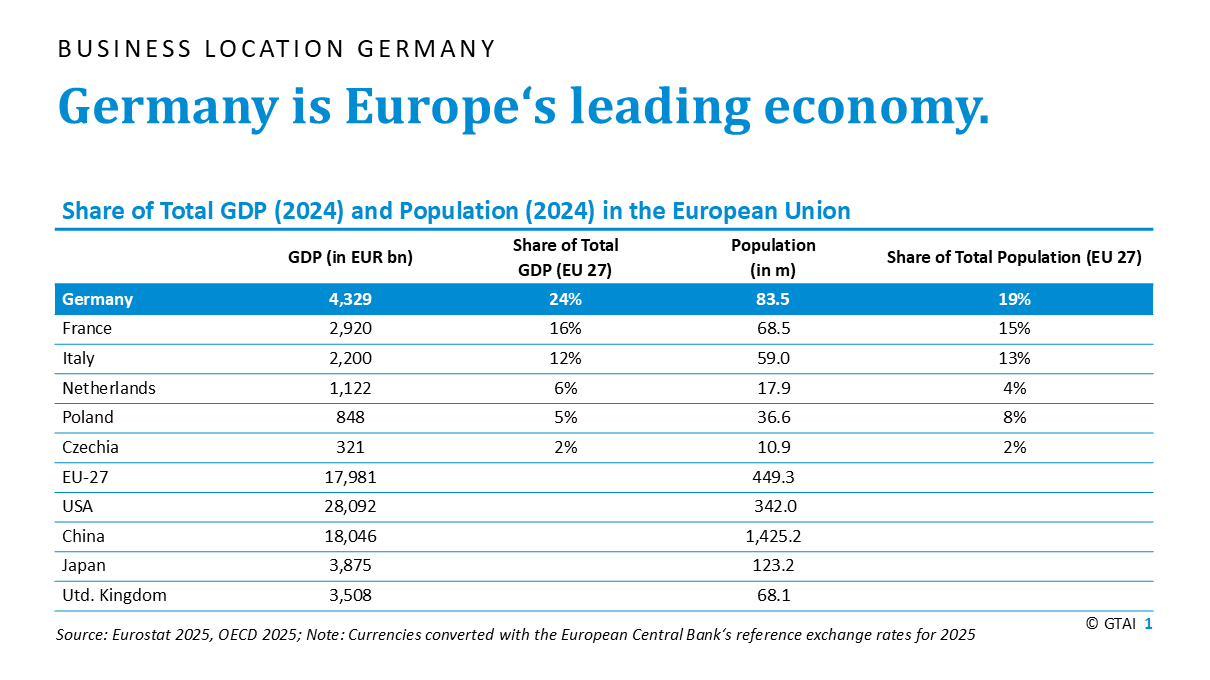
Germany is the world’s fourth largest economy. Small and medium-sized enterprises (SMEs) drive the market and promote dynamic trade relationships within Europe and beyond – offering plenty of business opportunities.
Germany's business friendly economic policies support a broad and competitive industry landscape with a strong focus on innovative future technologies. Many SMEs tap into this potential to become leaders in their respective markets. German products are worldwide export hits – across industries both large and small. A number of recent studies rank Germany as the top investment location in Europe. Enjoying relative economic stability, Germany is also the largest domestic market within Europe – creating a large and stable customer base for investors. Germany's integration into the world economy also allows companies to gain and share knowledge, products and employees within a global network.
Germany is the largest market in Europe. It constitutes 25 percent of Europe's GDP (EU-27) and is home to 19 percent of the total European Union (EU) population.
Germany accounts for almost 10 percent of Europe's manufacturing companies. They generate 29 percent of the EU's gross value added in the manufacturing sector alone. In fact, they represent more than one fifth of all of Germany's value added – one of the highest shares in Europe. Increasingly more international companies are placing their faith in Germany as an essential location for production sites. In doing so, they benefit from the country's excellent business framework and superior productivity rates.
Economic Backbone: Small and Medium-Sized Enterprises
Exports are driven by Germany’s backbone of highly innovative SMEs. They constitute more than 99.2 percent of all companies and employ 54 percent of all employees in Germany. Many of these SMEs are world market leaders in their respective niche segments. Together with internationally leading companies - such as Bayer, BASF, Daimler, Volkswagen, and Siemens to name but a few - they make up Germany’s manufacturing industrial base.
Company Structure in Germany (2022)
Total
SMEs
SME-Share
Number of Companies *
3.44 m
3.41 m
99.2%
Turnover of Companies *
EUR 9,775 bn
EUR 2,664 bn
27.3%
Employed *
35.65 m
19.12 m
53.6 %
Net Value-Added **
55.7 %
Source: Ifm Bonn 2024
All figures relate to the private sector (commercial business economy and the liberal professions without public sector, NACE Rev. 2 Codes A-N,P-S). Exceptions are marked. * Figures provided by the business register (NACE Rev. 2 Codes B-N,P-S). Differentiation of SMEs by number of employees and turnover ** Estimates by the IfM Bonn. Basic data: turnover tax statistics (VAT). Differentiation of SMEs by turnover
Log in and add this element to a dossier. Manage your dossiers and export them as PDF in your personal area. Find and add elements to your dossiers anywhere on the website.
Log in and add this element to a dossier. Manage your dossiers and export them as PDF in your personal area. Find and add elements to your dossiers anywhere on the website.
To improve our chatbot, we collect usage data, including IP addresses. Data processing is carried out via Microsoft Azure in data centers located within the EU. The data is used exclusively for statistical purposes and is deleted after 90 days. By using the AI search, you agree to our Terms of Use.