Future Mobility
Germany Going Fully Charged for the Future
Large-scale investments are accelerating the energy transition in Germany's public transport sector. Operators are electrifying their fleets and shifting to automated processes, creating a fast-growing market that supports climate goals and is opening doors for international companies.
Jun 15, 2026
Across Germany, cities, towns and other municipalities are pressing ahead with sustainable mobility. More than one in seven public buses is emission-free – most of them operating in Hamburg and Berlin.
Düsseldorf is also driving the shift: public transport operator Rheinbahn has opened one of Germany's most modern e-bus depots, where 60 electric buses can be charged simultaneously using green electricity from the facility's own photovoltaic system.
The project received backing from the state of North Rhine-Westphalia, which is committing nearly EUR 600m to the expansion of electric mobility.
Growing international opportunities
The public transportation transition is gaining real momentum throughout Germany. Regional transit companies stand to benefit – but so do international companies and start-ups, for whom a range of compelling market opportunities is opening up.
“Market entry is particularly successful through local partnerships, pilot projects with municipalities or transit companies, and early involvement in funding and procurement processes,” says Stefan Di Bitonto, technology expert at Germany Trade & Invest (GTAI). “The greatest market opportunities lie in integrated solutions – that is, the combination of vehicles, infrastructure, software, and services.” GTAI offers comprehensive support in identifying and navigating suitable funding opportunities.
In the fast lane
Thanks to growing investment appetite and targeted subsidy programs, electric propulsion has firmly established itself as the preferred technology in bus transportation in Germany. The numbers speak for themselves: in 2025, roughly twice as many electric buses were put into service as in the previous year, and nearly half of all new vehicles are now low-emission. According to the European Automobile Manufacturers' Association, that makes Germany the largest market in Europe by volume.
The growth opportunity has not gone unnoticed. Solaris from Poland, VDL and Ebusco from the Netherlands, and BYD from China are among the largest manufacturers of electric buses for German transit agencies, alongside domestic players Mercedes-Benz and MAN – a line-up that underscores just how international this market has already become.
Right on track
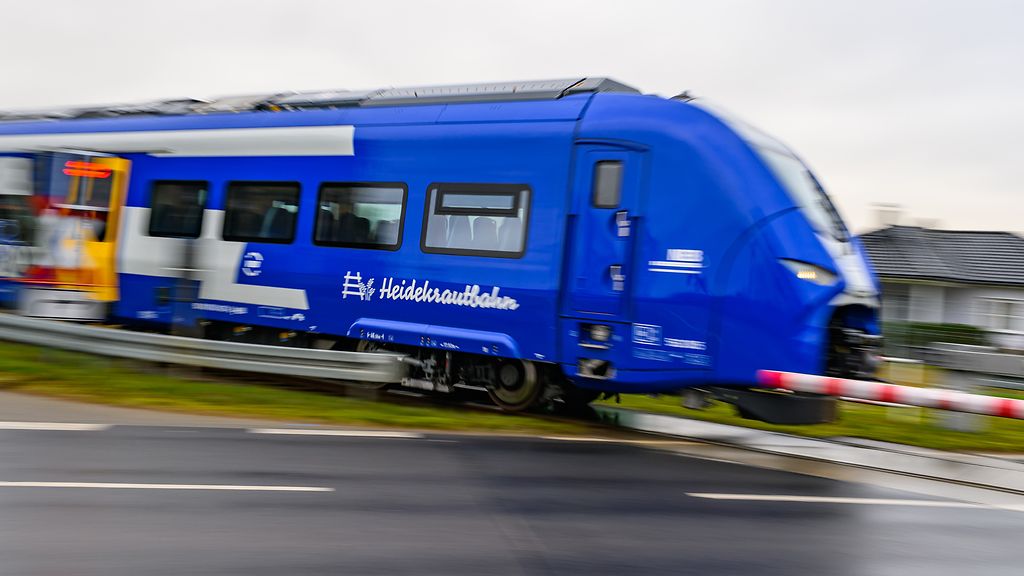
Momentum is growing in the rail sector too. Rail operator Deutsche Bahn has tested hydrogen-powered trains on routes in the state of Hesse and in the southern German city of Augsburg. Beyond battery- and hydrogen-powered trains, the automation of regional infrastructure is emerging as a decisive factor. “Digitalization and automation in rail transport are the key to more and more environmentally friendly mobility on the rails,” says Andreas Florez, Director of Public Affairs at the French train manufacturer Alstom.
Alstom is one of several leading manufacturers investing in German public transit. “In more than 30 German cities, Alstom vehicles transport people safely and sustainably from A to B.” Florez sees clear potential for further investment in Germany's sustainable infrastructure – and with an average market volume of around EUR 10 billion per year, Germany is Europe's largest rail market.
Jumping on the train
For international companies, the case for market entry is increasingly compelling as momentum in the market builds.
“The market is growing rapidly,” says Dagmar Fehler, CEO of the National Organisation for Sustainable Mobility (NOW). The road is now opening up for companies to bring innovative solutions to the table and to engage with municipal modernization projects at an early stage. Demand is particularly strong for vehicles and comprehensive system solutions that can be reliably integrated into existing operations."
“Those who are technological leaders today secure long-term partnerships,” Fehler adds.