Business Location Germany
Germany's Defense Industry Makes Turnaround
The war in Ukraine has fundamentally transformed Germany's security policy – and given rise to one of Europe's most dynamic defense markets.
Jun 03, 2026
At the Munich Security Conference in February 2026, Chancellor Friedrich Merz left listeners in no doubt about where things stand. "The international order that was based on rights and rules, it no longer exists in that form," he declared. A brave new era of open wars and conflicts has begun. Germany's response has been robust: Additional government borrowing will unlock around EUR 100 billion in investment for the Bundeswehr – the combined military forces of Germany – by 2030.
For international companies in the security and defense industry, this signals the emergence of a new and dynamic defense market – right in the heart of the European continent. The German government has announced a “Zeitenwende” – a fundamental turning point in security and defense policy that ends decades of strategic restraint and initiates a long-term expansion of public investment in defense capabilities.
More than government contracts
The prospect of lucrative government contracts is the most visible, but by no means the only, reason why Germany is becoming an increasingly attractive destination for international defense contractors, dual-use engineering firms, defense start-ups, and their suppliers. Achim Hartig, Managing Director of Germany Trade & Invest (GTAI), puts it plainly: “Germany's USP is the combination of technical know-how and deep pockets. It is an extremely attractive location for research, development, and production for international companies in industry and in adjacent sectors.” Additional benefits include targeted public funding and unparallelled market access across the European Union.
Thanks to harmonized EU law, companies that manufacture in Germany can supply other European armed forces with comparatively low barriers to entry, tapping into a market that is expanding at pace. According to data from the European Defence Agency, defense spending by EU member states rose by 11 percent in 2025 compared with the previous year – and by nearly 63 percent compared with 2020. A foothold in Germany doesn’t just provide access to the Bundeswehr, it opens the door to the entire European security and defense industry.
Opportunities beyond defense
This surge in demand has far-reaching implications. Defense companies need innovative suppliers of plant and mechanical engineering, electrical engineering, optics, and the metals and materials industries – sectors in which Germany traditionally excels. The Zeitenwende creates a new, high-growth market segment for these companies. The economic uplift is already measurable: German defense specialist Rheinmetall recorded a 29 percent increase in revenue in 2025; Diehl Defence increased its turnover by 39 percent.
According to Hans Christoph Atzpodien, Managing Director of the German defense industry association BDSV, this is just a taste of what’s to come: “The full re-equipment of the Bundeswehr by 2029, together with the planned increase in the German defense budget to 3.5 percent of GDP, poses a significant challenge for established companies in our industry. On a positive note, many market players not previously active in the defense sector are offering to use their resources to quickly bridge any bottlenecks. To make this possible, we have launched the SVI-Connect (https://www.svi-connect.com/) matchmaking platform.”
Companies seeking to tap this growth potential will find the operational foundations already in place in Germany: a mature industrial infrastructure and a deep pool of highly qualified technical professionals. For international companies looking to combine global technological leadership with local expertise, this is a very attractive proposition.
Martin Polak, Managing Director of Planet Labs – a U.S. company with a second base in Berlin – chose Germany because it offers “a unique trifecta of advantages: world-class talent, a robust industrial base, and a leadership position in the modern 'New Space' industry. The concentration of highly skilled engineers and researchers in Berlin and the surrounding region is unparalleled.”
Research and funding as a competitive advantage
Complementing this industrial foundation is a research ecosystem that is second to none. The Fraunhofer Institutes and the German Aerospace Center (DLR) conduct research in AI, sensor technology, and robotics. The clusters of excellence around the Technical University of Munich, RWTH Aachen University, and the University of the Bundeswehr drive application-oriented innovation, while platforms such as the German Aerospace Innovation Hub and the Cyber Innovation Hub of the Bundeswehr connect science and industry – lowering the threshold for international companies seeking to establish or expand their own R&D activities in Germany.
The public sector reinforces the growth of the defense market with targeted incentives. Beyond the Bundeswehr special fund, the EU’s proposed European Defence Industry Programme (EDIP) aims to strengthen Europe’s industrial base and boost joint production capacities. Through EDIP, companies and research institutes can receive support for collaborative projects that enhance technological capabilities and industrial resilience. The program particularly encourages cross-border cooperation in areas such as artificial intelligence, communication systems, and autonomous technologies – thereby nurturing the emergence of new clusters of excellence across Europe.
Growth markets: drones and reconnaissance
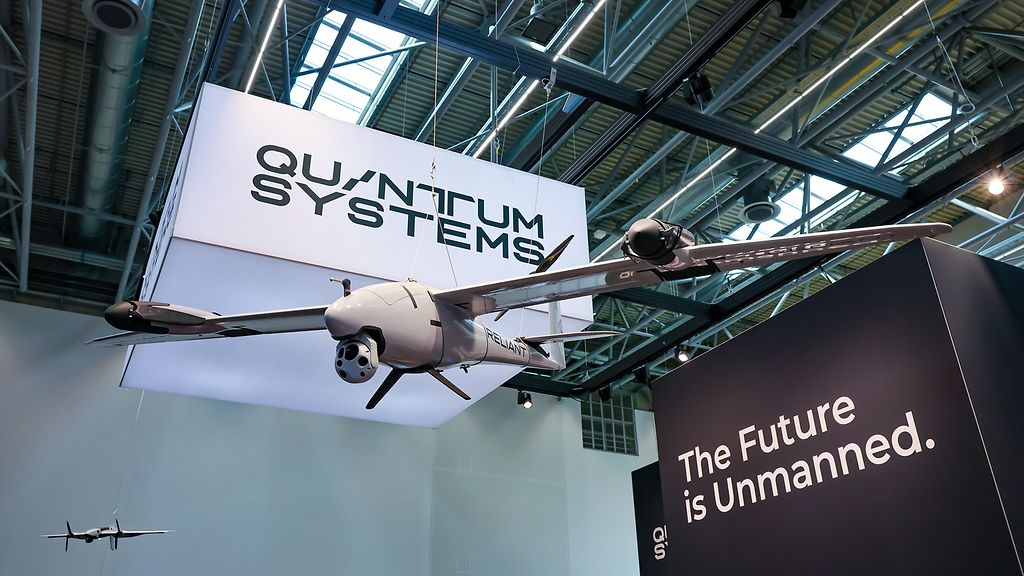
Where these locational advantages converge, new market leaders are already emerging. A particularly dynamic example is the submarket for drones and autonomous systems, which has received an enormous boost from the war in Ukraine. The Munich-based start-up Helsing, one of the industry's unicorns, valued at over EUR 1.6 billion, develops AI-based software for autonomous drone systems and has been collaborating with Swedish technology manufacturer Saab since 2023. Quantum Systems, based near Munich, goes a step further: The company develops and manufactures its own drones and has a joint venture with Ukrainian partners for direct deployment in the conflict.
Equally promising is the submarket for space-based reconnaissance. Satellite systems have become a central element of modern defense – and here, too, Germany is positioning itself as a leading development hub. Rheinmetall ICEYE Space Solutions, a German-Finnish joint-venture between Rheinmetall und ICEYE, is advancing SAR technology – a radar system that delivers high-resolution images of the Earth's surface regardless of time of day or weather conditions. “We see the integration of space capabilities as a key building block for the digital transformation of defense,” explains a spokesperson for Rheinmetall ICEYE Space Solutions. “As a European technology hub, Germany offers a unique combination of engineering excellence and a specialized supply industry that creates ideal synergies for joint ventures.”
Taken together, the combination of secure government demand, access to the EU market, a world-class production base, research excellence, and targeted funding makes Germany one of the most attractive locations worldwide for investment in defense tech right now. Achim Hartig of GTAI is unequivocal: “Germany currently offers a once-in-a-century opportunity for the defense industry.”
- Business Location Germany
- Industries