Markets Germany Magazine 3/25 | Energy
A Breath of Fresh Air
In Germany, cleantech start-ups and scale-ups benefit from an ideal environment to bring their ideas to market and take crucial steps toward growth — often by partnering with established industrial companies.
Dec 12, 2025
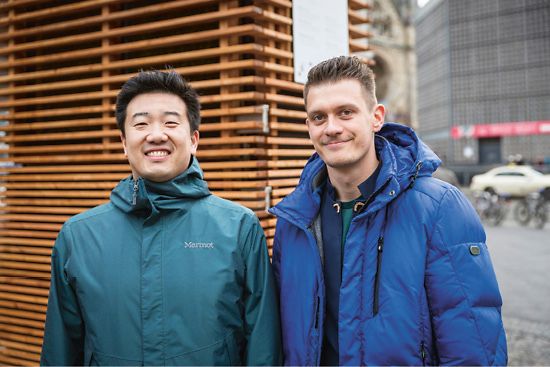
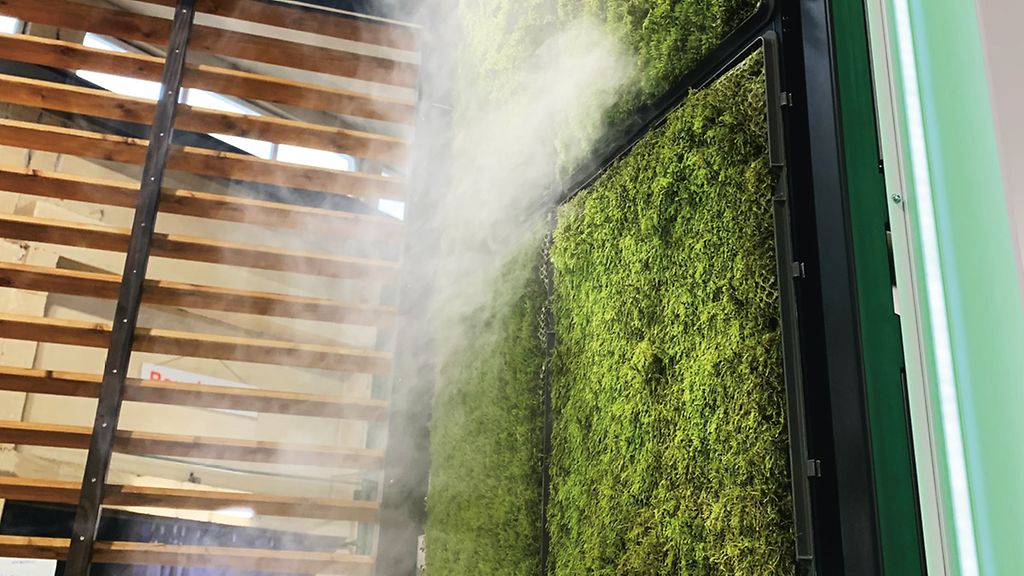
When Peter Sänger and Zhengliang Wu launched their greentech start-up, Green City Solutions, in 2014, they quickly realized that success would depend on winning over established companies as partners. The two met while studying at the Technical University of Dresden and went on to develop filter modules covered in specially cultivated moss. These modules can be installed along busy streets or in city squares, where they efficiently clean and cool the air.
“With just nine square meters of surface area, our moss modules deliver the same air-cooling effect as 81 trees,” says Sänger. It was a novel concept, so the first step was to make the technology market ready. The second was to demonstrate its value in real-world applications. Green City Solutions achieved both by partnering with established companies across various industries.

This article was published in issue 3-2025 of the Markets Germany Magazine. Read more articles of this issue here
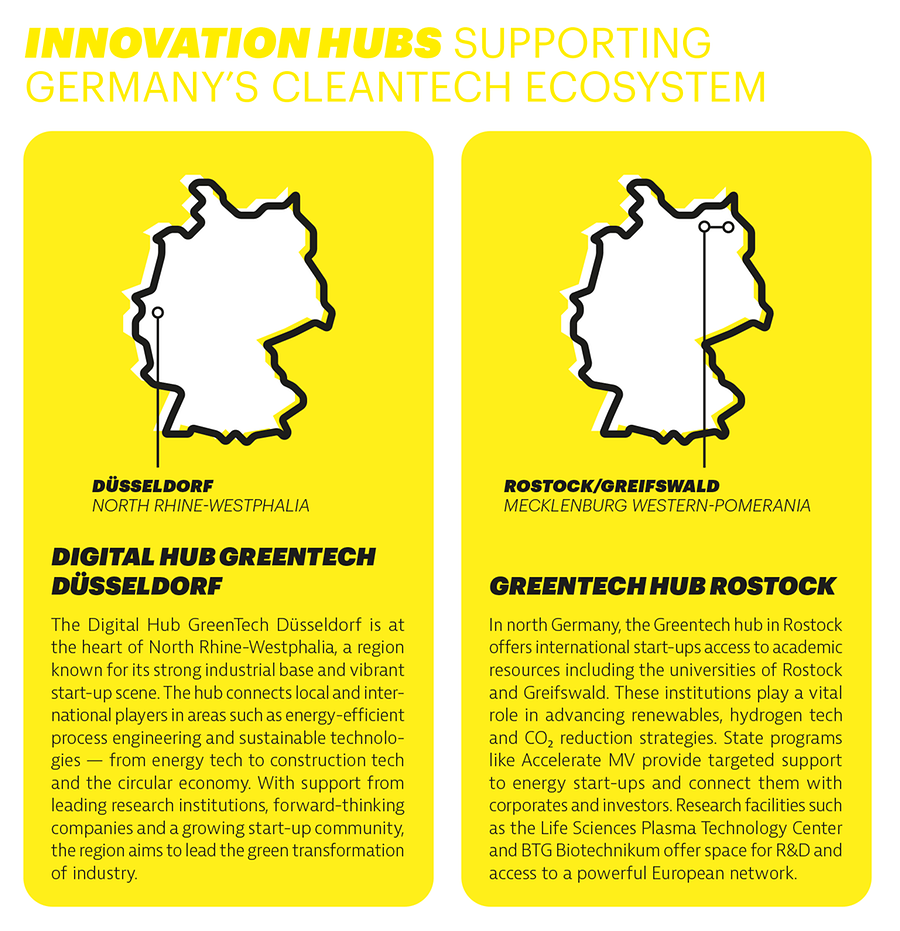
This approach — a successful strategy for many young companies — is especially effective for cleantech start-ups in Germany, says Christine Curtius, international relations lead at the digital hub GreenTech in Düsseldorf in the Rhineland. “For a start-up with a novel concept you have to tackle two challenges. First: advancing the technology to be market ready. And second: continuously demonstrating its value in real-world applications by partnering with players that are facing a problem.” Having founded her own greentech start-up, she speaks from experience: “Collaborations with established companies are crucial for cleantech start-ups to quickly develop their innovations, tailor them to customer needs and bring them to market.”
The Bottom Line
Start-ups in cleantech, climate tech and greentech are natural allies for German industrial firms seeking innovative solutions to decarbonize their operations and accelerate the energy transition.
Opportunities for these kinds of collaborations are plentiful in Germany. “The country’s decentralized industrial landscape and abundance of innovative mid-sized companies provide countless opportunities for collaboration,” Curtius notes. Medium-sized companies are particularly attractive as potential partners for cleantech start-ups, says Sänger. “They’re often family-run and genuinely interested in sustainable products and business models.”
Germany’s backbone
Sänger has first-hand experience of how Germany’s “Mittelstand” (its SME backbone) businesses operate, having grown up in an entrepreneurial family. One of the first companies to support Green City Solutions was his parents’ gardening business, which contributed its expertise and network. Soon after its founding, a partnership with Deutsche Telekom gave the start-up access to the smart city market and helped secure customers among municipalities and infrastructure providers.
active world-class patents in green technologies have been registered in Germany. This represents half of the European Union’s world-class patents in this field.
Source: Study Greentech
made in Germany, 2024
greentech start-ups are active in Germany. One in five greentech start-ups can be classified as a “deep tech” company, in the sense of bringing to market advanced technologies based on deep scientific or engineering innovation.
Source: Greentech Monitor 2025
Further down the line, the company teamed up with leading outdoor advertising firms to develop a method of using the moss modules as cooling elements for large digital displays. “As a start-up with a new, innovative concept, these partnerships were essential in building trust in both ourselves and our technology,” says Sänger. Dr. Jobst von Hoyningen-Huene also sees strategic partnerships as key to successfully positioning cleantech start-ups. A former investment banker, he co-founded the cleantech holding company Econnext with Michael Schneider in 2016. Together, they brought family offices from across Europe on board to back early-stage cleantech ventures under the Econnext umbrella.
“We support founders not just with capital, but more importantly by connecting them to companies and strategic partners from our network,” von Hoyningen-Huene explains. “We begin by identifying a partner with a strong industry reputation.” Established players help start-ups validate their technology, prove its added value and often support commercialization efforts. “That clear market focus is critical — especially for technically driven founding teams,” he adds.
Promising portfolio
Econnext’s portfolio now includes six start-ups, among them Berlin-based energy company Lumenion. Its high temperature storage systems deliver CO2-free process steam and heat from renewable energy sources to industrial clients. The German subsidiary of Swedish energy giant Vattenfall came on board as a partner. “Securing a partner early with such a strong reputation is a real vote of confidence for any start-up,” says von Hoyningen-Huene. Another good example is the partnership of FLAXRES, an econnext subsidiary that offers PV-module recycling technology and services, with Hyundai.
Germany’s diverse and technically advanced cleantech and climate tech ecosystem offers vast potential for collaboration between established firms and young innovators. Econnext is actively tapping into this potential because, as von Hoyningen-Huene argues, true environmental and social innovation doesn’t happen in isolation.