Startup
Germany's New Space Pioneer: Europe's Hottest Thermal Satellite Start-Up
Detecting forest fires before the first flames are even visible or tracking military targets with pinpoint precision – high-resolution thermal images of the Earth's surface are as versatile as they are valuable. Until recently, they were hard to access outside of government agencies, but the German start-up Constellr is changing that.
Aug 18, 2026
Read this article to find out:
- Why Constellr is the only commercial provider worldwide delivering defense-grade thermal intelligence.
- How thermal satellites detect threats from space.
- How 14 rejected grant applications led to one of Europe's hottest space start-ups.
Satellite images can reveal drought stress or pest infestations before crops show visible signs of distress, detect the thermal signature of a submarine up to an hour after it leaves port and monitor from a safe distance the activity of nuclear facilities or arms factories in conflict zones.
These are just some of the capabilities of the thermal satellites developed by Constellr. Rather than capturing visible light, they work by detecting infrared radiation – the heat emitted by objects – revealing what conventional imagery leaves hidden. The Munich-based start-up is a glowing example of the innovative potential within Germany's space technology sector.
“Compared to the rest of Europe, Germany is the powerhouse of the New Space sector.”
Rainer Müller, GTAI
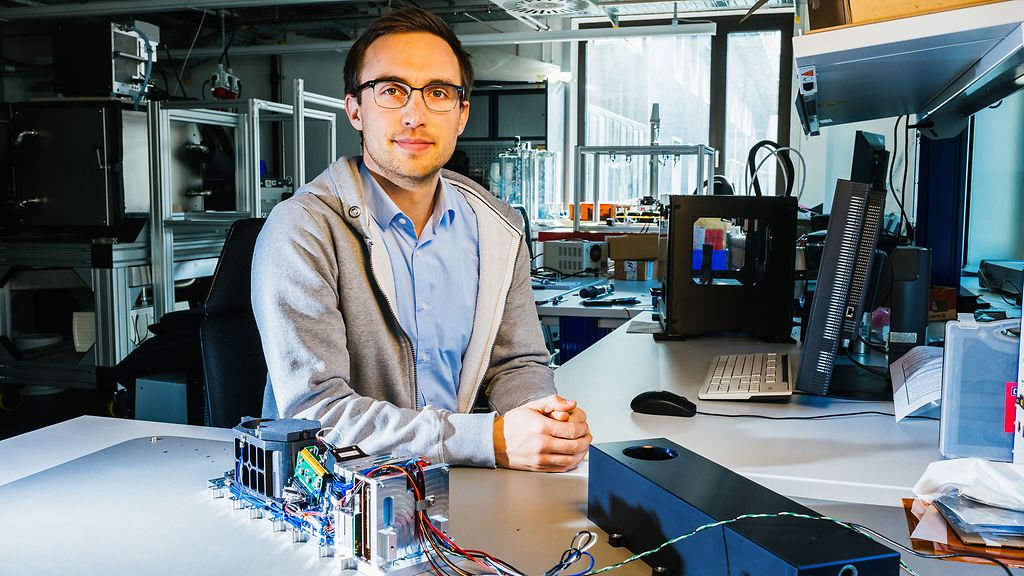
Constellr's key competitive advantage lies in miniaturization. Conventional thermal satellites are the size of a small bus and cost several hundred million euros each. Constellr shrank high-precision thermal sensors to fit on 115-kilogram microsatellites the size of a washing machine, significantly cutting expenditures.
“Our costs are roughly one to two percent of what a comparable conventional mission would incur”, says Constellr CEO Max Gulde.
Gulde and his co-founder Marius Bierdel conceived the idea in 2017 while working at the Fraunhofer Institute for High-Speed Dynamics in Freiburg. But despite a promising start, the path to commercialization was anything but smooth.
“Back then, we submitted 14 research funding applications, and all 14 were rejected," Gulde recalls. Undeterred, the two researchers left their positions and founded Constellr in 2020 together with Christian Mittermaier, today the company's Chief Commercial Officer. Over the following five years, the team moved rapidly from laboratory experiments to operational satellites.
Two are currently in orbit, delivering daily temperature data at a 30-meter resolution, with a next generation of satellites in development providing a resolution below 5 meters.
Decision-grade intelligence
Constellr sells these insights to corporate clients as well as government and military customers. A second generation of satellites offering a resolution of five meters or better is planned for launch by 2028. And by 2032, the company aims to expand its constellation to the point where it can capture data on any location on Earth every 30 minutes.
Constellr at a glance
- Founded: 2020 in Freiburg
- Status: €75 million total funding raised (2026)
- Product: High-precision thermal infrared satellite data
- Customers: Governments and defense agencies, agricultural enterprises, energy and infrastructure operators
- Investors: Alpine Space Ventures (Lead), Lakestar (Co-Lead), Semapa Next, Cardumen Capital
That combination of scientific rigor and lean execution has secured Constellr a strong strategic position. The start-up recently relocated its headquarters to Munich – to the heart of the cluster formed by aerospace and defense giants Airbus, OHB and Helsing. Additional offices in Berlin, Toulouse and the United States ensure access to international talent.
In February 2026, Constellr closed a Series A funding round worth EUR 37 million, confirming its status as one of the most promising companies in Europe's fast-growing New Space sector.
Rainer Müller of Germany Trade & Invest (GTAI) is not surprised that this success story unfolded in Germany. “Compared to the rest of Europe, Germany is the powerhouse of the New Space sector,” he says. “For the first time in its history, the German government is investing heavily in the space industry – through both civil programs and the armed forces.”
Want to benefit from Germany’s space expertise?
Dr. Rainer Müller
GTAI’s industry expert