Artifical Intelligence
Satellite Data and AI: Railways, Power Grids, and Pipelines from Space
In times of climate crisis and geopolitical conflict, protecting critical infrastructure has never mattered more. Yet monitoring railway lines, power grids, and pipelines is labor-intensive and costly. Berlin-based start-up LiveEO wants to change that – with satellite data and artificial intelligence.
Sep 30, 2026
Read this article to find out:
- How critical infrastructure can be monitored from space
- What makes Berlin-based start-up LiveEO tick
- Germany's space-tech advantages
It started with a specific and highly localized problem: trees falling onto railway lines. In January 2018, a massive storm swept across Europe, causing an estimated one billion euros in damage in Germany alone. Rail operator Deutsche Bahn reported damage on 200 sections of track.
LiveEO had a way to help. The technology developed by the Berlin-based start-up analyzes railway lines automatically and comprehensively – and does so at a scale and speed conventional methods cannot match.
“Where traditional satellite analysis merely shows forests from above, our technology identifies the height of individual trees and, with it, the potential danger to route safety. And it does so within a single second,” explains Sven Przywarra, co-CEO of LiveEO.
The technique relies on so-called stereo satellite imagery: a location is captured from two different angles, producing high-resolution 3D models. AI algorithms then process these models to detect vegetation height, the proximity of trees to power lines, and a range of other risks.
LiveEO at a glance
- Founded: 2018 in Berlin
- Product: two services for the infrastructure sector
- Customers: Over 100 worldwide (including BPA British Pipeline Agency, Deutsche Bahn, Dominion Energy, Liberty Utilities and San Francisco Public Utilities Commission)
- Investors: Greencode Ventures, Helantic, Segenia Capital
Satellites ‘Made in Germany’
By its own account, LiveEO is the largest European company capable of analyzing satellite data three-dimensionally and fully automatically – a distinction that sets it apart from other analytics firms. Founders Sven Przywarra and Daniel Seidel offer two products for the infrastructure sector, with which they can monitor more than one million kilometers of assets including vegetation along power lines and railways, construction projects and excavation sites. They can also track surface changes caused by erosion or similar events to assess the structural integrity of pipelines.
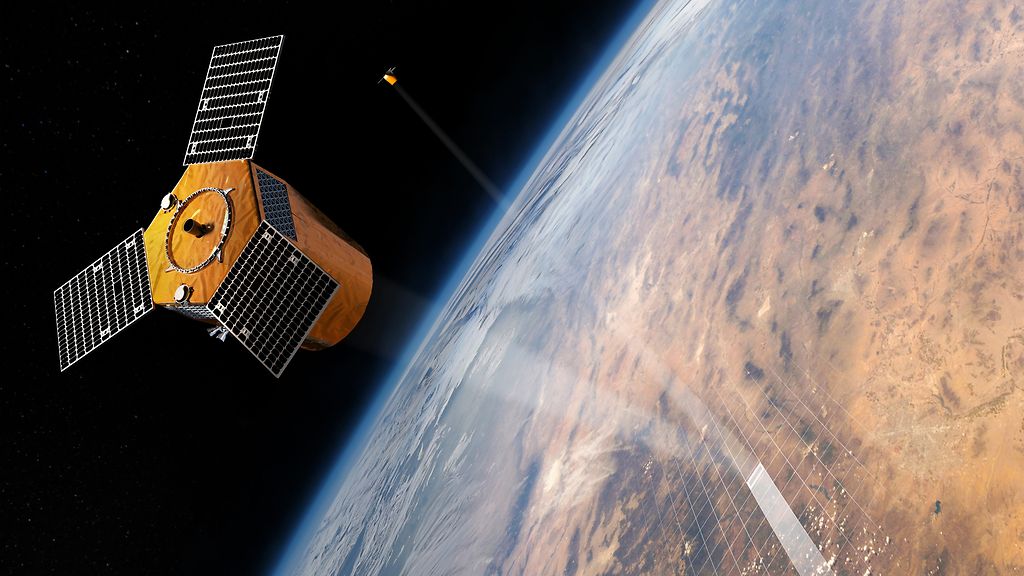
A further competitive edge is in the making. In early 2026, LiveEO announced plans to operate its own self-developed satellites under the name Twinspector – with backing from the European Space Agency (ESA) and the German Aerospace Center (DLR). The planned launch date is the tail end of 2028.
“The German space industry is closely networked and capable of covering almost every critical component of the value chain. LiveEO is in excellent company here.”
Rainer Müller, GTAI
The transition from buyer of satellite data to satellite operator follows a clear commercial logic. Przywarra and his team expected prices for satellite data to fall. The war in Ukraine, however, drove up demand for Earth observation data, and prices remained stubbornly high. At the same time, the cost of building satellites dropped significantly. The make-or-buy calculation therefore tipped in favor of in-house hardware.
Notably, the Twinspector project draws heavily on German value creation. For the construction of its hardware, LiveEO is collaborating with Reflex Aerospace from Berlin, as well as with Engineering Minds Munich and Kampf Telescope Optics (KTO), also from Munich. In an international tender for the camera system, KTO prevailed against dozens of global competitors.
GTAI’s Rainer Müller touts the favorable conditions for new space companies in Germany: “The German space industry is closely networked and capable of covering almost every critical component of the value chain. LiveEO is in excellent company here,” he says.
Excellence in space
LiveEO today employs around 160 people, with a subsidiary in Latvia, offices in the United States and branches in the United Kingdom. After winning a start-up competition organized by the German Ministry for Economic Affairs and Energy, the company secured capital from the state-backed Deep Tech & Climate Fund – which supports start-ups focused on future technologies and climate action – and drew on funding from ESA, DLR and the European Commission. Most recently, in May 2026, LiveEO sealed a new funding round worth more than EUR 28 million.
Shifting security needs have also opened a new customer segment. The data analysis architecture LiveEO has refined over the years is well suited to help the German armed forces close capability gaps in reconnaissance – a market that, until recently, would have seemed a long way from the trees of the company's origin.
Want to benefit from Germany’s space industry expertise?
Dr. Rainer Müller
GTAI’s Industry Expert