Artifical Intelligence
Three Arguments for AI Made in Germany
Germany is not a country given to making grand claims, it is a place that gets results. Artificial Intelligence has been integrated into its industrial infrastructure for some time, optimizing logistics and enabling machines to anticipate what comes next. And for corporate decision-makers and founders, that emphasis on substance over spectacle really matters.
Jun 24, 2026
Read this article to find out…
- why Germany with 935 AI start-ups outpaces even France
- which world-class research institutions are incubating the next generation of AI unicorns
- how sovereign AI infrastructure is giving Germany a competitive advantage
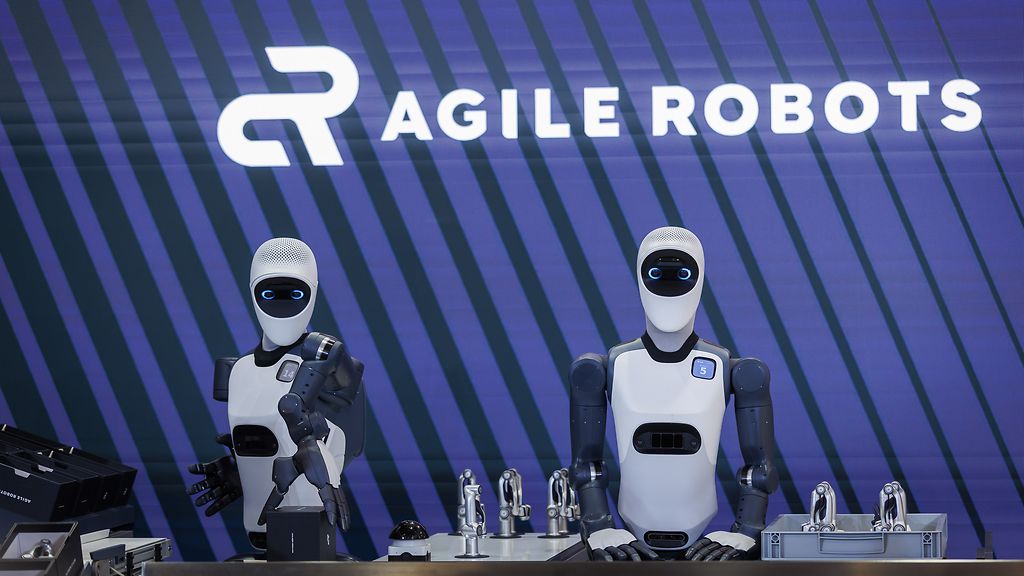
Imagine the scene. Intelligent robots are busily constructing a new factory hall and production lines on which even more humanoids will be assembled. No, it’s not the opening of a new science fiction movie. This is Bavaria in 2026.
Some 25 kilometers west of Munich, close to the picturesque town of Fürstenfeldbruck, a new production facility for the AI company Agile Robots is currently taking shape. Founded in 2018, the company has doubled its revenue every year since inception, reaching EUR 200m in 2024. “We see Agile One as part of a perfectly coordinated automation solution, where every system is interconnected and learns from each other,” says founder Zhaopeng Chen. Most recently, Agile Robots announced a partnership with Google, integrating the tech giant's Gemini AI model into its robotics technology.
Agile Robots is far from an isolated case. In recent years, Germany has been quietly establishing itself as one of Europe's leading AI hubs. According to the appliedAI Institute, there are 935 AI start-ups in the country – roughly a third more than in France. Many of them work in close partnership with established industry partners, developing the specific capabilities that manufacturers and logistics operators urgently need. Germany’s industrial powerhouse has a great deal to offer these young companies.
1. Strong industrial foundation
“Germany is building AI for physical value creation – at a globally leading level,” writes Martin Talmeier, Head of Change & AI in SMEs at the Hasso Plattner Institute for Digital Engineering, in his blog.
Talmeier has put his finger on what sets the country’s AI sector apart from its European neighbors: its focus on “physical AI” – systems that don’t just simulate thought processes but translate them into coordinated action in the real world. The spectrum runs from quality control in manufacturing and AI-assisted logistics to autonomous robotics, drone technology, medical assistance systems, and care robots.
“We have an outstanding industrial foundation in Germany,” says Jörg Bienert of the German AI Association, who has himself launched several AI start-ups. “Thanks to the many manufacturing companies here, there are enormous volumes of data and deep experience with production processes.”
The evidence is plentiful. Siemens is using AI to optimize complex manufacturing processes and energy networks. BMW is running a pilot project with humanoid robots at its Leipzig plant. Munich-based Helsin, meanwhile, has emerged as one of Europe's leading companies in AI-assisted defense technology.
“We have excellent incubators such as UnternehmerTUM in Munich. And at the same time, values like reliability, and security are traditionally held in high regard in Germany.”
Jörg Bienert, German AI Association
2. Research that breeds start-ups
Germany boasts a dense landscape of high-caliber AI research institutions from which spin-offs emerge with notable regularity. Agile Robots is a prime example. The company grew directly out of the German Aerospace Center: scientists became entrepreneurs and academic expertise was translated into industrial product. Time and time again, German R&D creates pathways to success.
“We have excellent incubators, such as UnternehmerTUM in Munich,” says Bienert. “Founders can find top-tier talent here. And at the same time, values like reliability, and security are traditionally held in high regard in Germany.”
Another case in point is Black Forest Labs. Founders Robin Rombach, Andreas Blattmann and Axel Sauer studied in Heidelberg and Munich. They then worked at Stability AI in London, before establishing their own company in Freiburg in 2024. Their image generation model FLUX is now considered one of the most powerful of its kind in the world.
The interplay of three factors: talent, science and industrial demand is what makes Germany fertile ground for founders. The Munich region, for example, benefits from its proximity to global corporations Siemens and BMW – natural partners for any AI start-up focused on industrial applications. A recent study by the German digital industry association Bitkom confirms that this home advantage is real: 93 per cent of German companies and 69 per cent of the population say they prefer AI solutions developed in Germany.
Four of the most important AI research institutes in Germany
1. German Research Centre for Artificial Intelligence (DFKI)
Locations: Kaiserslautern, Saarbrücken, Bremen, Osnabrück, and others
Specialization: It claims to be Europe's largest AI research institute, with a broad spectrum from robotics and natural language processing to industrial AI, and a strong focus on technology transfer to industry and spin-offs.
2. Hasso Plattner Institute for Digital Engineering (HPI)
Location: Potsdam
Specialization: Artificial intelligence in the areas of cybersecurity, data mining, and human-computer interaction. Best known for practical training and applied computer science research with industry, as well as societal relevance.
3. Fraunhofer Institute for Intelligent Analysis and Information Systems (IAIS)
Location: Sankt Augustin (near Bonn)
Specialization: Applied AI for businesses and the public sector. Focus areas include large language models, explainable AI, and secure AI systems. One of the core institutes behind the SOOFI project.
4. Munich Center for Machine Learning (MCML)
Location: Munich
Specialization: Basic research in the field of machine learning and closely linked to the Technical University of Munich and Ludwig Maximilian University of Munich. One of Germany's six national AI competence centers, it is particularly strong in deep learning and scientific AI.
3. Sovereign AI and legal certainty
Germany is also making its mark in the field of large-scale foundation models. Behind the SOOFI (“Sovereign Open Source Foundation Models”) acronym lies the most ambitious project in this space to date: An open model with approximately 100bn parameters, trained on the Industrial AI Cloud of Deutsche Telekom and backed by EUR 20m from the German Federal Ministry for Economic Affairs and Energy. The consortium brings together the Fraunhofer Institute for Applied Research, the German Research Center for Artificial Intelligence (DFKI), several universities, and two start-ups under the leadership of the German AI Association.
The latest Bitkom study also shows that appetite for AI investment in Germany is growing – 29 per cent of German companies plan to increase their AI spending compared with the previous year. The market is starting to gather momentum.
“We are at the very beginning of this development,” says Bienert. “Companies' capacity to reshape their business processes with the help of AI is constantly expanding.”
The recent partnership between SAP and OpenAI has sent a clear signal. Through OpenAI for Germany, the two companies are bringing AI to German public administration – with data sovereignty, legal compliance, and infrastructure based entirely on German soil. SAP is expanding its Delos Cloud to 4,000 GPUs and has pledged more than EUR 20bn toward strengthening Europe's digital sovereignty. The German government is adding political weight to the project: AI is forecast to account for up to 10 per cent of Germany's GDP by 2030. The “Made for Germany” initiative demonstrates that investors are responding positively – 61 leading companies have already committed more than EUR 631bn.
FDI Insight: More Than Numbers
GTAI's AI expert Asha-Maria Sharma explains why Germany's most compelling locational advantages are not to be found in a spreadsheet.
Key performance indicators are where a location decision begins but rarely where it ends. Look beyond the numbers, and you will find substance and quality in AI that’s Made in Germany.
Planning certainty. The German government is making targeted investments in data-center expansion. By 2030, AI-capable computing capacity is set to quadruple. This is underpinned by 28 concrete measures – among them streamlined permitting, tax incentives and a binding commitment to 100 per cent renewable energy. For companies with long investment horizons, this is not a footnote. It’s a guarantee.
Regulatory reliability. The partnership between SAP and OpenAI in Germany shows data sovereignty and AI scaling are not mutually exclusive. Germany provides the legal architecture that international companies need to build AI infrastructure they can trust and their customers need.
An ecosystem that engages. German authorities, research institutions and industry partners don’t exist in their respective ivory towers – they collaborate. Companies investing in Germany will discover not only a market, but a network of partners willing to think alongside them.
AI hub with substance
Germany may not generate the loudest headlines in the global AI race, but it is making quiet progress where it counts – above all in physical AI applications. Its strengths lie not in the showcase but on the factory floor and in the research laboratory. That’s why every year it attracts more international investors and founders who want to build AI for B2B.
Want to know more about Germany’s AI scene?
Asha-Maria Sharma
GTAI’s AI expert