Digital Economy
Diamond-Powered Quantum Revolution
Most quantum computers today are bulky machines that demand elaborate cooling systems. Leipzig-based start-up XeedQ hopes to change all that by building computers around diamonds. The company exemplifies German innovation at its best: product development that’s rooted in deep research, with a clear path to international markets.
Aug 11, 2026
Read this article to find out:
- Why diamonds could be the key to compact, room-temperature quantum computing
- How XeedQ turned deep academic research into a marketable product
- Why Germany is becoming a global hub for industrial quantum technology
For Gopi Balasubramanian, the move from laboratory to product development was the only logical next step. Determined that his technology should not languish in the theoretical boondocks – as so many brilliant ideas do – he resigned his position at the Leibniz Institute of Surface Engineering and threw himself entirely into building the world's first compact, diamond-based quantum computer. In 2021, the physicist founded XeedQ in Leipzig, eastern Germany, bringing nearly two decades of experience harnessing diamonds for quantum technologies.
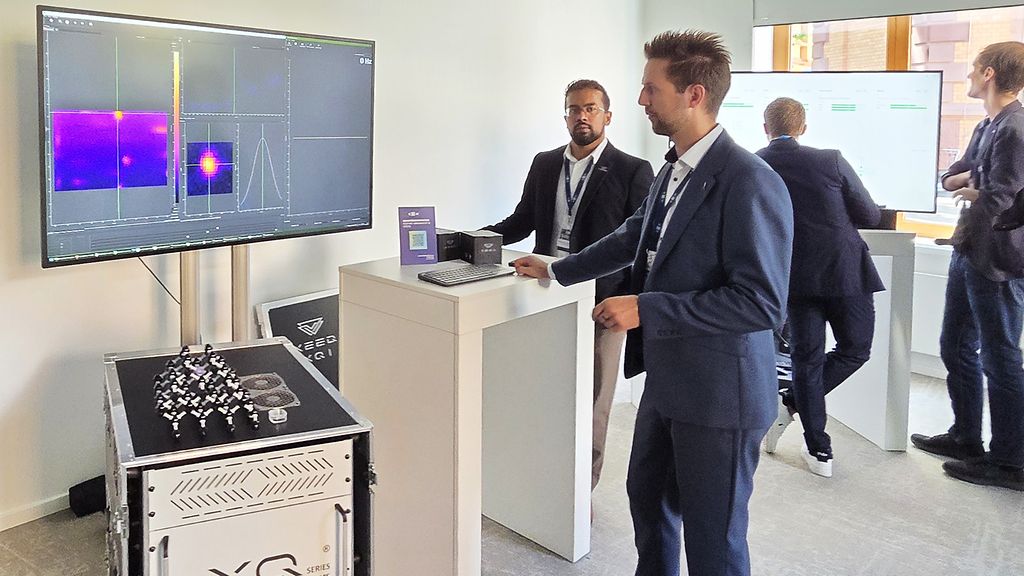
The promise of quantum computing is immense. These machines can solve problems that would defeat even the fastest supercomputer. Yet most quantum computers are still enormous, require cooling to within a fraction of absolute zero – minus 273 degrees Celsius – and are therefore firmly rooted to the spot. The XeedQ team is building something fundamentally different: a mobile quantum computer that operates at room temperature, making it far more versatile than anything currently on the market.
“The prototype was ready for use in 2021,” Balasubramanian recalls, “and gave us a crucial advantage when the German Aerospace Center (DLR) began working on quantum computers and was looking for technology partners.” The DLR became XeedQ's first customer. Other research institutions soon followed.
Stable quantum states
At the heart of XeedQ's technology are synthetic diamonds, produced industrially and cost-effectively from methane. Diamonds are hard, transparent, and exhibit exceptionally rigid bonds in their crystal structure – properties that allow individual atoms to be controlled with great precision, providing the hardware foundation for modern quantum computers.
In theory, a single diamond crystal could yield up to one million qubits. A qubit – or quantum bit – is the smallest unit of computation in a quantum computer, analogous to a bit in classical computing.
XeedQ's current systems operate with a more modest eight qubits. In the coming years, the company plans to scale up to a diamond-based quantum computer with around 2,000 qubits.
Benjamin Lilienthal-Uhlig of the Fraunhofer Institute for Photonic Microsystems (IPMS) in Dresden is upbeat about the potential. “XeedQ offers ready-made, plug-and-play devices that allow users to test quantum algorithms with minimal barriers to entry,” he says. “Companies interested in quantum computing can use these simpler systems to train their employees, for example.”
“XeedQ shows that industrial quantum applications in Germany are no longer just a pipe dream.”
Peggy Görlitz, GTAI
Quantum for industry
XeedQ is simultaneously working on concrete industrial applications – in robotics and pharmaceutical research, for instance – where quantum computers can model complex systems that would overwhelm any conventional machine.
It is no accident that this development happened in Germany. Diamond-based quantum technology was substantially shaped at German universities and Max Planck Institutes, particularly in Stuttgart and Ulm. XeedQ is headquartered in Leipzig, while its R&D team works primarily in Ulm, embedded in a strong regional ecosystem of universities, the DLR, and other research institutions.
For Peggy Görlitz of GTAI, XeedQ is proof that industrial quantum applications in Germany are no longer the stuff of dreams. “Companies like XeedQ attract international capital, partners, and further innovation,” she says. “They are the starting point for a true Industrial Quantum Valley.”
The appeal of diamond-based quantum technology extends well beyond Germany's borders. XeedQ has already established a subsidiary in the United States, where demand is rising – as it is in Europe – for quantum systems that companies can deploy without major hurdles. In this way, XeedQ is steadily positioning itself as the bridge between cutting-edge basic research and industrial application: a company that is taking quantum computing out of the laboratory and onto the factory floor.
Want to know more about Germany’s quantum technology?
Peggy Görlitz
GTAI’s automation & robotics expert