


Markets Germany Magazine 3/25 | Innovations
Innovations
The global business community admires the spirit of invention that drives the German economy. Here we highlight some of the most intriguing trends and research projects.
Jan 08, 2026
From Manure to Cure
A research team in eastern Germany has achieved a scientific breakthrough in cancer therapies.
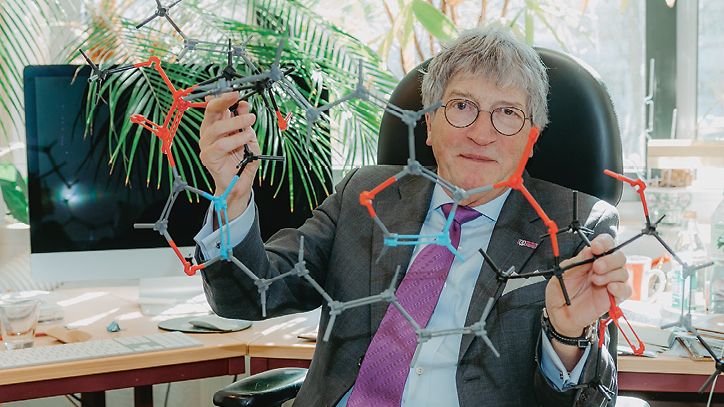
Chemists at Otto von Guericke University Magdeburg (OVGU) have succeeded in synthesizing a natural anti-cancer agent in the laboratory. The compound Disorazol Z1 is normally produced by bacteria found in organic waste such as goat manure. The substance is considered highly effective in combatting cancer, as it prevents the growth of and can selectively destroy human and animal cells. According to research leader Dieter Schinzer from the Institute of Chemistry at OVGU, the laboratory synthesis makes it possible to produce the compound in larger quantities for the first time. The researchers’ goal is to modify the molecule so that it binds exclusively to a certain antibody, allowing it to reach tumors, where the compound inhibits the division of cancer cells. “In collaboration with industry, the substance will now be further developed so that it attacks cancer cells precisely while largely sparing healthy cells,” explains Schinzer. The research project has a budget of EUR 1.7 million and is funded by the regional German state of Saxony-Anhalt and the European Regional Development Fund (ERDF).
This article was published in issue 3-2025 of the Markets Germany Magazine. Read more articles of this issue here
Extreme Performance Mirrors
Laser-driven fusion reactors could be a viable source of clean energy in the future. A team of German scientists is developing extremely robust mirrors to enable the technology.
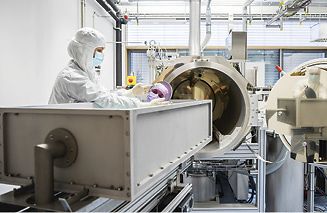
Laser-driven fusion reactors could play a crucial role in achieving climate neutrality. The technology is based on the fusion of atomic nuclei releasing vast amounts of energy — similar to what happens in the Sun. Multiple high-power lasers focus their light onto a small fuel capsule, heating it to extreme temperatures and generating the pressure needed to initiate fusion. High-performance mirrors are needed to guide the laser beams precisely, while withstanding extreme optical, mechanical and thermal stress. This is exactly what the German SHARP (short for Scalable Highpower Reflectors for Petawatts) research consortium is working on.
In addition to ensuring the stability of these high-performance mirrors, the consortium of renowned research institutes (including the Fraunhofer Society) and industry partners (such as glass manufacturer Schott) is developing scalable manufacturing processes, paving the way for future commercial use — for example, in high-power material processing, aerospace applications and EUV lithography. Launched in March, the project will run for three years and is supported by EUR 8.4 million in funding from the German Ministry for Research, Technology and Space.
Quantum AI Made in Heilbronn
From cybersecurity to quantum AI, a city in Baden-Württemberg is becoming a hotspot for artificial intelligence.
The Fraunhofer Society is significantly expanding its activities in the city of Heilbronn, Baden-Württemberg. Thanks to a funding agreement with a regional foundation, the city will soon be home to eight Fraunhofer research and innovation centers, collectively known as the Fraunhofer Heilbronn Research and Innovation Centers (HNFIZ). The aim is to focus on key future technologies and transfer research findings to industries. AI will play a pivotal role in this, particularly in hybrid artificial intelligence, AI-based robotics and application-oriented quantum AI. The objective is to devise solutions to issues such as demographic change, skilled labor shortage and core sustainability challenges. Heilbronn is rapidly developing an innovative AI ecosystem with the Innovation Park Artificial Intelligence (IPAI), which will bring together companies, research institutions, start-ups and public stakeholders to jointly develop and implement AI solutions. From late 2025, real-world AI laboratories, data centers and workspaces for over 5,000 people are set to be constructed on a 30-hectare site.
www.hnfiz.fraunhofer.de, www.ip.ai

Downsizing Silicon Wafers
Infineon is boosting microchip efficiency with the world’s thinnest silicon wafers.
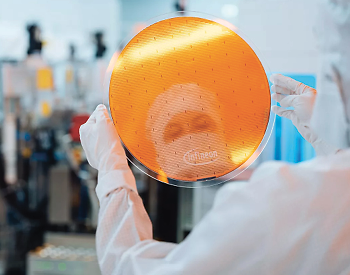
The round wafers used by the leading German semiconductor manufacturer Infineon to produce microchips are just 0.02 millimeters thick — a quarter of the diameter of a human hair. Infineon engineers have developed a new grinding process that enables the production of extremely thin wafers with particular precision. These semiconductors are primarily intended for use in AI data centers. “Semiconductors have to work particularly efficiently where a lot of electricity is converted in a small space,” says Richard Kunčič, Head of the Power Systems division at Infineon. “This minimizes the amount of energy lost as heat.” The thinner the wafer, the shorter the current’s path, as electrical resistance decreases. Consequently, Infineon can reduce energy loss in its chips by up to 15 percent. The company has already successfully tested the new technology with customers and used it in power supply modules.
Super-Healing Space Bandages
The Institute of Lightweight Engineering and Polymer Technology (ILK) in Dresden is developing a new type of wound gel bandage for astronauts.
Wounds heal poorly in space due to the disruptive effects of radiation and weightlessness on the natural healing process. The German research team StellarHeal, which includes experts from institutions like ILK, aims to address this issue. The scientists are developing a new type of bandage for space travellers that significantly accelerates the healing process. The new bandage contains cold gel with healing cells that enter the wound directly to stop the bleeding. It also supports the formation of healthy tissue and fights infections until the bandage breaks down by itself.
The biggest challenge is ensuring that the healing cells and gel remain effective over a long period of time. ILK scientists have solved this by developing a unique artificial tissue that can be safely frozen. This innovative plaster could also enable new treatment possibilities for patients with chronic wounds.
Satellite Propulsion Simulators
Researchers in Dresden have developed a vacuum chamber to test a novel propulsion system for satellites.
Until now aerospace companies have avoided orbits below 250 kilometers because the atmosphere at this altitude is dense enough to slow satellites down, eventually causing them to crash, and compensating for this drag would require huge amounts of fuel. The solution: innovative propulsion systems that allow satellites to use the surrounding air as propellant. Aerospace experts at the Technical University of Dresden have built a special space simulator to test the concept, including a vacuum chamber where researchers can realistically simulate how these new propulsion systems would operate in orbit.
Operating satellites in lower orbits offers several advantages: closer proximity to Earth reduces signal delays, enabling observation satellites to capture much higher-resolution images, and space debris burns up more quickly due to higher atmospheric drag. “With this innovative propulsion technology, satellites could theoretically operate indefinitely,” explains Martin Tajmar, who leads the Residual Atmosphere Simulator project. The European Space Agency-funded project is set to continue until March 2027.