Robotics, Automation
German Robotics About to Get Far More Human
Humanoid robotics in Germany is entering a new development phase. The first systems are set to fundamentally transform industrial production – and they are almost ready for market.
Jun 04, 2026
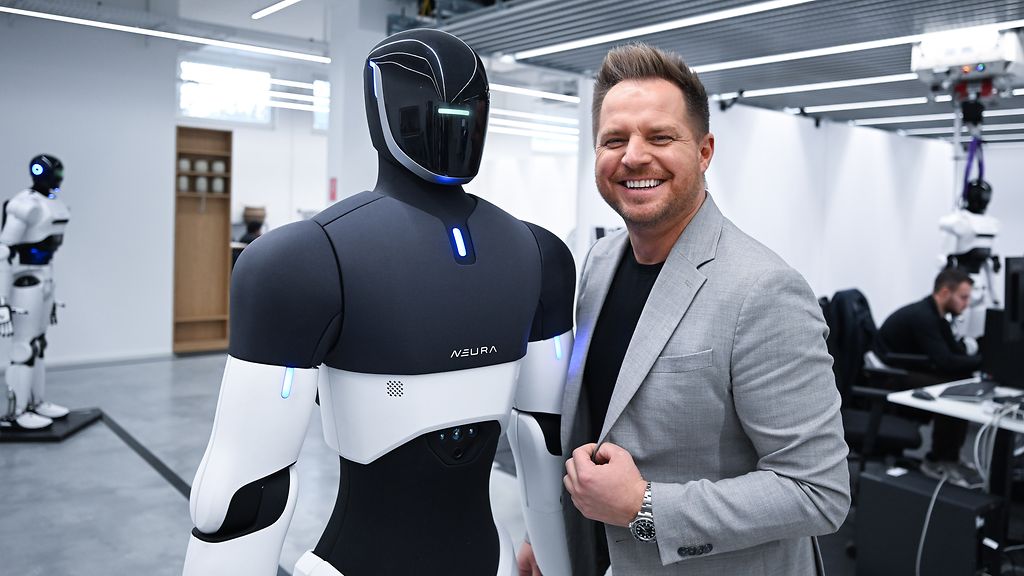
This year some of the most innovative companies working in robotics – including Tesla, Boston Dynamics, and Neura Robotics – are set to launch a new generation of humanoid robots for industrial use. Powered by advances in AI, sensor technology, and energy efficiency, the “new gen” has reached the next level of technical maturity and are powerful and reliable enough to perform complex tasks in production and logistics autonomously.
Propelled by a shortage of skilled workers and mounting pressure to improve efficiency, analysts forecast dynamic market growth: global humanoid robot sales are projected to be between USD 80 and USD 150bn per year by 2035 at the latest.
Strong environment for investment, research and application
As Europe's largest industrial hub, Germany offers humanoid robot developers and manufacturers a particularly attractive environment, observes GTAI expert Peggy Görlitz. “Highly networked industry clusters, cutting-edge research in robotics and AI, proximity to OEMs like the automotive industry, and direct access to the entire market within the European Union provide attractive locational advantages.”
Robots are already deeply embedded into German industry. According to the International Federation of Robotics, almost one in two industrial robots operating within the European Union is found in Germany – a testament to the country's high degree of automation and an indication of its openness to new technologies. This is good news for humanoid robot manufacturers: Germany's flagship industries – automotive, mechanical and plant engineering, aviation, logistics, and chemicals – offer a wide range of applications for these systems.
Humanoid droids from international manufacturers are already at work at numerous companies in Germany, including automakers such as Mercedes-Benz. Together with the U.S. company Apptronik, Mercedes-Benz is deploying the Apollo robot for logistics tasks at its own AI training center in Berlin. In the long term, the robot is also expected to take on complex assembly processes, working side by side with employees.
“Humanoid robots and AI take over the tasks we usually enjoy less, giving us time to focus on real innovation, creativity, and value-adding activities,” says Katrin Lehmann, Chief Information Officer of the Mercedes-Benz Group.
Southern Germany: A Hotspot for Robotics Innovation
Germany is also a vital hub for research in the field. Munich, in particular, is emerging as one of the world's leading robotics ecosystems. And clusters such as the Munich Robotics Network actively foster collaboration between companies, research institutions, and investors. It’s no coincidence that Agile Robots and Neura Robotics – the two best-known German robotics companies – are both based in Southern Germany. Munich is betting big on robotics: The world's largest robot training center dedicated to developing AI systems capable of learning and acting autonomously is set to open there in 2026.
A second hotspot for AI and robotics is taking shape in Heilbronn, in southern Germany. At the local innovation campus there, the Fraunhofer Society, the Technical University of Munich, and the Swiss Federal Institute of Technology (ETH) Zurich work in close collaboration with affiliated organizations.
“The close integration of industry and research, as well as the growing number of deep-tech startups, offers great potential for financial and scientific investments,” says Simon Schmidt of the Fraunhofer Institute for Manufacturing Engineering and Automation IPA.
One stand-out example is Prehensio, a Fraunhofer IPA spin-off in Stuttgart and Heilbronn that develops AI-based software for robotic hands.
The networked branches of Germany's robotics research landscape spread out beyond the borders of Munich and Heilbronn: The German Aerospace Center (DLR), the Karlsruhe Institute of Technology (KIT), the German Research Center for Artificial Intelligence (DFKI), and the Robotics Institute Germany (RIG) are all actively shaping the future of robotics.
Germany’s research strength combined with the growing domestic demand for humanoid systems is cementing the country’s role as a central European hub for next generation industrial innovation, according to GTAI expert Görlitz. “We are seeing increasing interest from international companies in Germany as a business location. And we stand ready to support these companies in their location selection.”