Markets Germany Magazine 3/25 | Technology
Germany`s Quantum Leap
Scientists around the world are advancing quantum computing, and Germany is emerging as a global leader. Robert Axmann, Director of the DLR Quantum Computing Initiative (DLR QCI), explains how international companies can tap into Germany’s growing quantum ecosystem.
Dec 03, 2025
Mr. Axmann, the DLR QCI aims to further develop Germany’s quantum computing ecosystem. Why is this so critical for Germany?
Robert Axmann: Quantum computers have the potential to perform calculations thousands of times faster than conventional systems and tackle problems that classical computers simply can’t solve. The range of applications is vast: Quantum sensors, for instance, offer far greater precision than traditional technologies and can be used in fields like medicine and construction. Quantum technology also plays a key role in secure data transmission. In short, this is a foundational technology. For Germany — an industrial and technological powerhouse — it is crucial to be at the forefront of this revolution.
Does this make Germany an attractive hub for companies developing quantum computers?
RA: Absolutely. Companies here benefit from an excellent environment: Germany has a strong basis in atomic physics, outstanding training in quantum optics and quantum physics, and a deep talent pool. In addition, collaboration between academia and industry is particularly close, which is essential for innovation.
What is your organization doing to further strengthen this ecosystem?
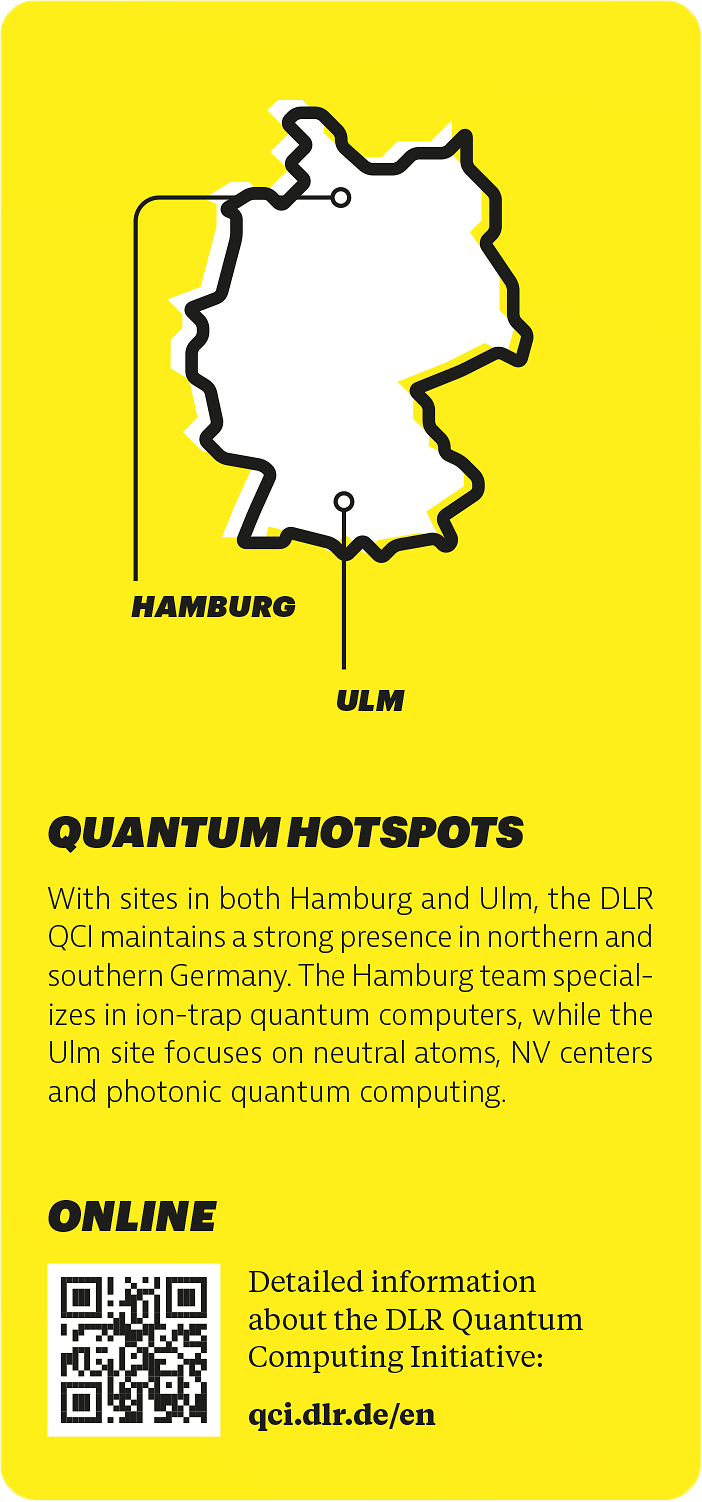
RA: As a public research institution that works hand in hand with industry, we serve as a bridge between deep-tech start-ups, established companies and academia. Our mission is to co-develop quantum technologies with all stakeholders, always keeping practical applications in mind. To support this, we issue EU-wide calls for projects — for example, to develop quantum error correction codes for ion-trap quantum computers. These projects are 100 percent publicly funded, which is quite rare. Typically, public funding covers only 70 to 80 percent, leaving companies to finance the rest. This is often a challenge in such a high-cost field. Our funding comes from the German Ministry of Research, Technology and Space. Currently, over 60 application-driven projects are underway, involving 28 industrial partners.

This article was published in issue 3-2025 of the Markets Germany Magazine. Read more articles of this issue here
What opportunities are there for international companies to participate in these publicly funded projects?
RA: We publish calls for proposals across Europe, and several international firms are already involved. For example, UK-based Universal Quantum is developing two prototype ion-trap quantum computers for us, while Quix Quantum from the Netherlands delivered the first photonic processor last May. That processor is now being used to explore photon sources for future quantum processors.
The funding for these quantum initiatives was approved by the previous German government. What can we expect of the new administration?
RA: While specific plans are still being finalized, the new government has clearly identified quantum technologies as one of its strategic priorities in its coalition agreement. We’re confident that support will continue. We’re already seeing the returns on recent investments. Germany now leads globally in quantum-related patent applications.
Which industries in Germany stand to benefit the most from quantum computing in the not-so-distant future?
RA: Logistics stands out as a prime early beneficiary. Coordinating freight transport across rail, road and sea quickly pushes conventional planning systems to their limits. Quantum computing can optimize these complex supply chains. We see similar opportunities in energy grid management, as well as in the chemical and automotive sectors, all of which are strong in Germany. And if quantum algorithms reduce steel waste in a car factory or increase daily output by even two percent, that could translate into a significant competitive edge.