Artifical Intelligence
Industrial Strength Meets AI Infrastructure
NVIDIA and Deutsche Telekom have joined forces to open one of Europe’s largest AI data factories in Munich. The move means the EU’s most attractive industrial AI market is now fully accessible and business opportunities for international players have never been greater.
Jul 15, 2026
Read this article to find out:
- Why Germany is ahead of the game in industrial AI
- How the new Industrial AI Cloud accelerates this global advantage
- Which three market segments are ripe for investment
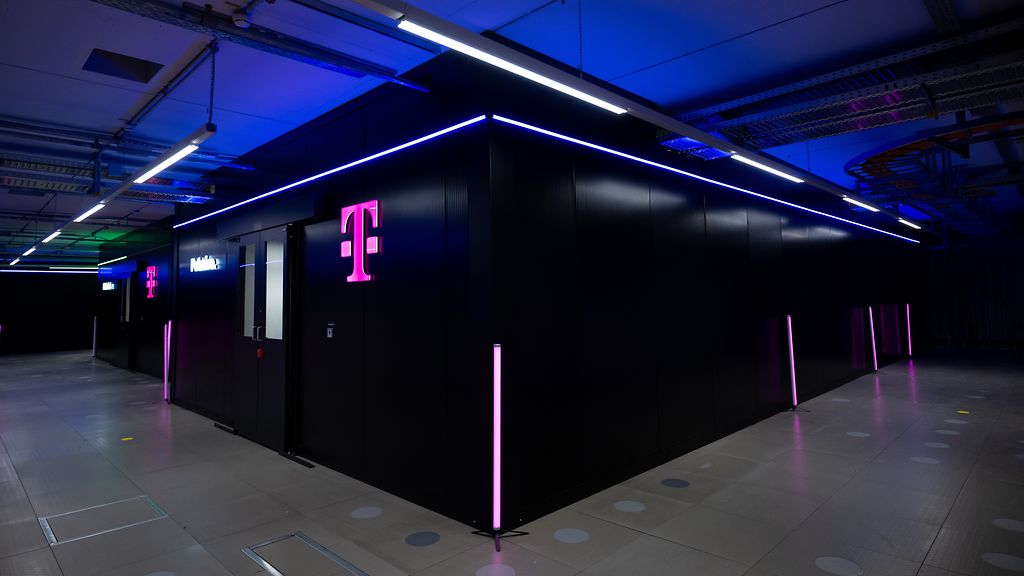
In November 2025, Jensen Huang and Timotheus Höttges appeared together before the press in Berlin – relaxed and at ease, as though the chief executives of NVIDIA and Deutsche Telekom made a habit of launching billion-euro projects together. What they were unveiling was one of Europe's largest AI factories: the Industrial AI Cloud. Opened a few months later in Munich, it houses 10,000 water-cooled GPU processors, runs entirely on renewable energy, and meets European security standards. It cost around one billion euros to build and took just six months.
Huang was in no doubt about the significance of the launch: “I think this is going to be the beginning of a new phase of growth and innovation for Germany,” he said. The starting gun had been fired.
For companies developing or scaling industrial AI solutions, the Munich announcement marked a genuine inflection point. What had long been missing was large-scale, high-performance computing capacity that meets industrial requirements while complying with European data protection standards. The Industrial AI Cloud has closed that gap. Business opportunities within Germany's industrial AI ecosystem are now greater, more accessible, and more concrete than at any point before.
Infrastructure investments of this kind represent a turning point, says Asha-Maria Sharma, an AI expert at GTAI. “They make industrial AI truly usable for a significantly wider range of companies – thereby opening up a market whose potential was previously limited primarily by a lack of infrastructure.”
“For industrial AI, Germany plays a role that can, in many ways, be compared to Silicon Valley in digital platforms.”
Martin Talmeier, Hasso Plattner Institute
Turbocharging German manufacturing
Artificial intelligence has been at work on German factory floors for nearly two decades for jobs such as optimizing production processes, interpreting machine sensor data in real time, and synchronizing facilities across continents. But that head start has been constrained by a shortage of computing capacity. The new infrastructure changes the calculus: models that were previously too computationally intensive for widespread deployment can now be scaled. Applications that companies have spent years developing but had not yet rolled out are finally becoming viable.
Martin Talmeier of the Hasso Plattner Institute (HPI) spells out the potential for investors and growth partners: “The greater the available computing power, the more the use of industrial AI in Germany will gain momentum – starting from an already high level. For industrial AI, Germany plays a role that can, in many ways, be compared to Silicon Valley in digital platforms.”
Where High-Tech Becomes ROI
1. Simulation and development
In industries such as automotive, mechanical engineering and chemicals, development cycles are long and testing costs are high. AI compresses both significantly. For international providers of simulation and development tools, the message is clear: Germany has customers who understand the value of such solutions – and are ready to get their wallets out.
2. Real-time process optimization
In less than a second, data from a sensor registered in Munich can optimize a production process in Istanbul. This advanced connectivity is made possible by a combination of factors: ‘Tiny Language Models’ running directly on machines, 5G connectivity, and ‘Industrial Foundation Models’ operating in the background. What the market needs now are scalable software solutions and experienced system integrators to bring it all together.
3. Assurance and trustworthy AI
Industrial AI cannot afford to make mistakes. When something goes wrong on a pharmaceutical production line, the consequences can be dire. This reality is giving rise to an independent and fast-growing market segment: quality assurance, certification, and the protection of AI systems in industrial use.
Low latency, high trust
Germany has no shortage of conventional data centers. The problem is that most are ill-suited to industrial AI applications: their capacity is calibrated for standard IT workloads, not for the intensive computations required to train and operate large industrial AI models. The Industrial AI Cloud is different. Tens of thousands of GPU processors work together as a single, unified AI machine – optimized for industrial requirements and available as a scalable cloud service. Companies developing or operating industrial AI solutions no longer need to build this infrastructure themselves; they can simply use the cloud and focus their efforts on core value creation.
But raw computing power is only part of the appeal. In German industry, data sovereignty has been a precondition for the adoption of AI. The data involved is highly sensitive – spanning production and development processes and potentially valuable trade secrets. The mistrust that previously held many industrial companies back from committing to AI is now fading.
“The fact that the Industrial AI Cloud is operated by a German company builds trust,” says Mario Trapp of the Fraunhofer Institute for Cognitive Systems (IKS).
Trapp sees this generating a pull effect that accelerates the entire ecosystem: the more companies adopt industrial AI, the more will follow – making the market progressively more attractive for those developing and supplying solutions.
Market dynamics are already confirming the trend – and faster than expected. Just months after the Munich facility came online, Telekom CEO Höttges announced plans to double its capacity – from 10,000 to 20,000 NVIDIA GPUs. The European Union, meanwhile, is planning tenders for AI “gigafactories” capable of housing at least 100,000 GPUs. Other providers are moving in the same direction: German IT services group Schwarz Digits is working on comparable infrastructure.
The pebble that dropped in Munich earlier this year will continue to ripple out across the continent and beyond.
Want to know more about Germany’s AI scene?
Asha-Maria Sharma
GTAI’s AI expert