Robotics, Automation
Why Small German Manufacturers Are Automating
Pressure to remain competitive and a new generation of affordable, AI-powered robots are attracting Germany's small and medium-sized manufacturing companies. It’s a further plus in one of the world's most dynamic robotics markets.
Sep 23, 2026
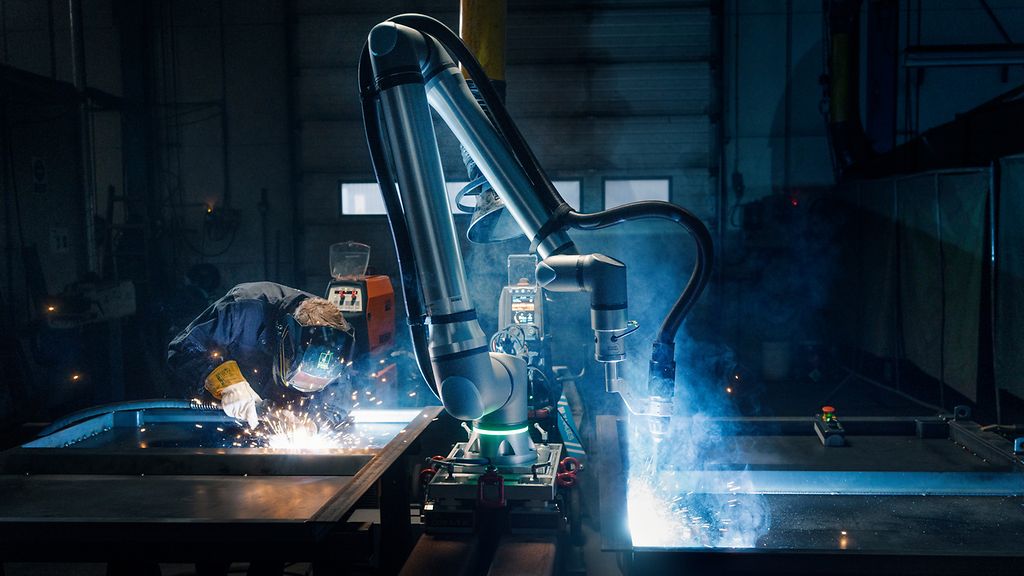
Most small businesses have no use for a robot that performs the same task day in, day out, year after year. What they need is a machine that can handle five different jobs today and five entirely different ones tomorrow. A new generation of welding robots can do just that: weld one seam with precision and tireless efficiency today, a completely different one tomorrow – programmed not by a specialist engineer but by the metalworker himself, who trains the device by physically guiding its arm.
For robotics manufacturers, a new growth market is emerging in Germany. A persistent shortage of skilled workers, combined with mounting competitive pressure, is compelling small and medium-sized enterprises (SMEs) to rethink their processes. Increasingly, they are turning to robots. Cheaper system solutions and artificial intelligence are making automation financially viable for a range of fabricators and producers that would once have considered it beyond reach.
“A large proportion of companies in the German manufacturing sector are small or medium-sized,” observes Peggy Görlitz, robotics expert at GTAI. “And these companies are now investing heavily in automation to increase productivity.”
Robots enter the workshop
Susanne Bieller, Secretary General of the International Federation of Robotics, agrees with that assessment. She sees the greatest growth opportunities for robotics not among Germany's industrial giants, but among its SMEs. “German medium-sized businesses are far from exhausting their automation potential.”
That prospect is already drawing attention from international robot manufacturers. Universal Robots, the Danish specialist in lightweight robots, counts German SMEs among the most important markets in the world, with what it sees as excellent growth prospects. The company is consciously expanding its presence in Germany.
“We are observing that more and more SMEs in Germany are investing in automation,” says Fabian Schäll, Head of Sales DACH at Universal Robots. “They are doing so in order to survive economically challenging times.”
Working together
Universal Robots specializes in so-called cobots – robots designed to work alongside people rather than replace them. This makes them particularly well suited to the needs of many medium-sized companies. Rather than simply selling off-the-shelf solutions, the Danes are actively seeking out SME partners with whom they can develop and refine products together.
One such collaboration with the German welding machine manufacturer Lorch has produced a new generation of welding robots: built for cooperation with human workers in workshops across the country, capable of learning through AI and quick to integrate because on-site colleagues can train the machine without any deep programming knowledge.
Schäll sees considerable potential in partnerships of this kind: “Together, we are moving away from standalone robots and towards integrated approaches that solve the real problems German medium-sized companies face.”
A gateway to Europe
Korean robotics manufacturer Yujin Robot also sees significant commercial potential in Germany. The company specializes in Autonomous Mobile Robots (AMRs) – self-navigating machines that handle internal logistics in settings ranging from production halls and warehouses to hospitals.
Marcus Liebhardt, Head of AMS Europe at Yujin Robot, identifies particular promise among German SMEs. “Many companies face increasing labor shortages and cost pressure while still relying on manual internal transport processes.” He also notes a strong willingness among German businesses to invest in productivity-enhancing technologies.
It is precisely this combination – a large, receptive market populated by engaged users – that makes Germany the destination of choice for robotics manufacturers. Geography adds another dimension. “Germany is both a gateway to the wider European market and one of its most important reference markets. Success here helps companies build credibility and expand across Europe,” says Liebhardt.
Across the continent, SMEs in many other countries face similar market dynamics and the need to invest to keep up with the competition. For robotics companies with ambitions beyond a single European market, Germany is not merely a final destination. It’s a springboard.